Posted:
Spark is Magic Me’s flagship creativity in care homes project. It’s award winning – its combination of artist-led training and care home visits won the 2026 Creative Arts and Culture in Dementia Award at the UK Dementia Awards
Devised originally for Magic Me by our Associate Artists Billy and Georgia, Spark supports everyone’s right to creative expression, through training, resources and delivery with staff and residents in care homes. Activities focus on the sensory – light, colour, texture – suiting people who communicate non-verbally. All the ideas, which include paper marbling, light and shadow play, cyanotypes, poetry and weaving, use inexpensive, easily available materials and equipment. Activities can be adapted for 1-2-1 or group work, and can take place in various locations including bedrooms, communal spaces and outdoors. Sensory activities don’t need to be childish. Spark encourages playful, imaginative participation, while offering respectful choices of materials and content.
We know Spark works to keep residents active, communicating and connecting – statistics and feedback prove it. But we keep the project fresh and updated – constantly trialling new techniques, and working with dementia specialists to make sure that we’re incorporating the very latest best practice in dementia care and care home practice. The artists who deliver Spark work closely with staff and residents to test new ideas both in homes and back in the studio, based on feedback and how activities are received in the care homes. Partners, participants and funders deserve to know that Spark’s innovations are both forward thinking and effective.
Currently, we’re working on new versions of Spark which involve residents’ family and friends; and we’re also collaborating with arts, health and wellbeing researchers Unmapped to find new ways to evaluate projects which involve those living with a dementia. We’re also very proud of the initial steps we’ve taken to ensure Spark is welcoming for people of all cultural backgrounds, and for those who like to move as well as make.
Cultural sensitivity
Not only are the cultural backgrounds of care home residents mixed and diverse, but those of the care home staff who work there are too. We keep reviewing Spark techniques to ensure that everyone can find a connection to the activities. Natural inks are a big Spark favourite – making them, painting with them, enjoying the artworks that fellow residents create. If you’ve eaten beetroot all your life, beetroot makes a familiar, reassuring magenta mark on a page – but what if you haven’t? Sorrel tea, turmeric powder and coffee might be the everyday equivalent for you. Likewise, with music. Music fills the room as Spark activities take place. We ask staff and residents to select their own favourite songs or genres which often brings a whole new range of music into the care homes. We don’t make the presumption that everyone in the home has the same taste or reference points. Because Spark works for residents who are non-verbal, it doesn’t rely on language for communication – so if English isn’t or wasn’t your first language, it doesn’t matter. We aim to connect, laugh and share moments through engaging images and moments – sometimes with no words exchanged at all.
Stretch & Shimmy
Thanks to a grant from London Sport’s Test & Learn pilot fund, we’ve recently experimented with expanding Spark’s creative vocabulary to include movement and dance!
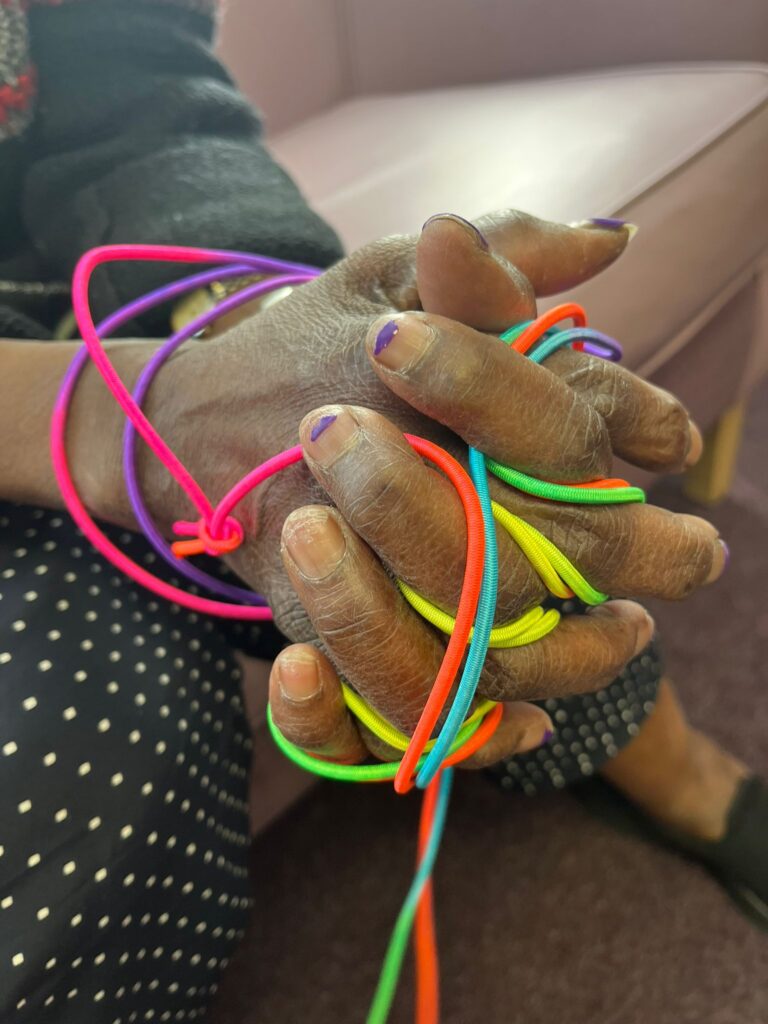
Charlene was the Magic Me Associate Artist who helped us test this new way of working – weaving shapes in the air with music, colourful scarves and giant elastic bands, and looking for expressive ways to help residents maintain dexterity and balance.
We noted the positive changes seen in the residents after the activities – ‘The large colourful elastic band was a great activity to connect residents that were slightly more shy or disengaged. One resident led the artists movement through using the band.’ read one note. Another recorded ‘A lady who was in bed to start slowly started to sit up in bed, then moved to sit on the side of the bed, then rolled her sleeves up. At each change she moved so that she could better engage with the scarf activity. It was as if the activity lifted her energy.’
What’s Next?
Once analysed, the findings from the Unmapped research will feed in to the next generation of Spark activities. Meanwhile, if you’re connected to a local authority, individual home or care home chain and would like to talk to us about bringing Spark – in any of its versions – to you, please get in touch at info@magicme.co.uk